01FOR THE CIO
Lead the
architecture
conversation.
Walk into a board meeting able to answer two questions clearly: is our portfolio aligned to strategy, and is our AI use governed. Cost and risk signals — pulled in through connectors — sit beside the alignment they affect.
DEMO
From app list to board number in a minute
We take a raw application list, run it through Atlas, and land on a Portfolio Health score with drill-down. No setup, no slides, just the flow.
02
The board conversation, prepared
One number you can defend
Portfolio Health rolls cost, risk, ownership, and lifecycle into a single score — with drill-down for the moment someone asks where it comes from.
Architecture in board language
Health, risk, alignment, and ROI attribution in one view. The same clarity your CFO brings to the financials, applied to the portfolio.
Continuity through change
Decisions stay linked to the systems they shaped. When roles change, the portfolio memory stays structural, not personal.
03Portfolio health
One number the board understands
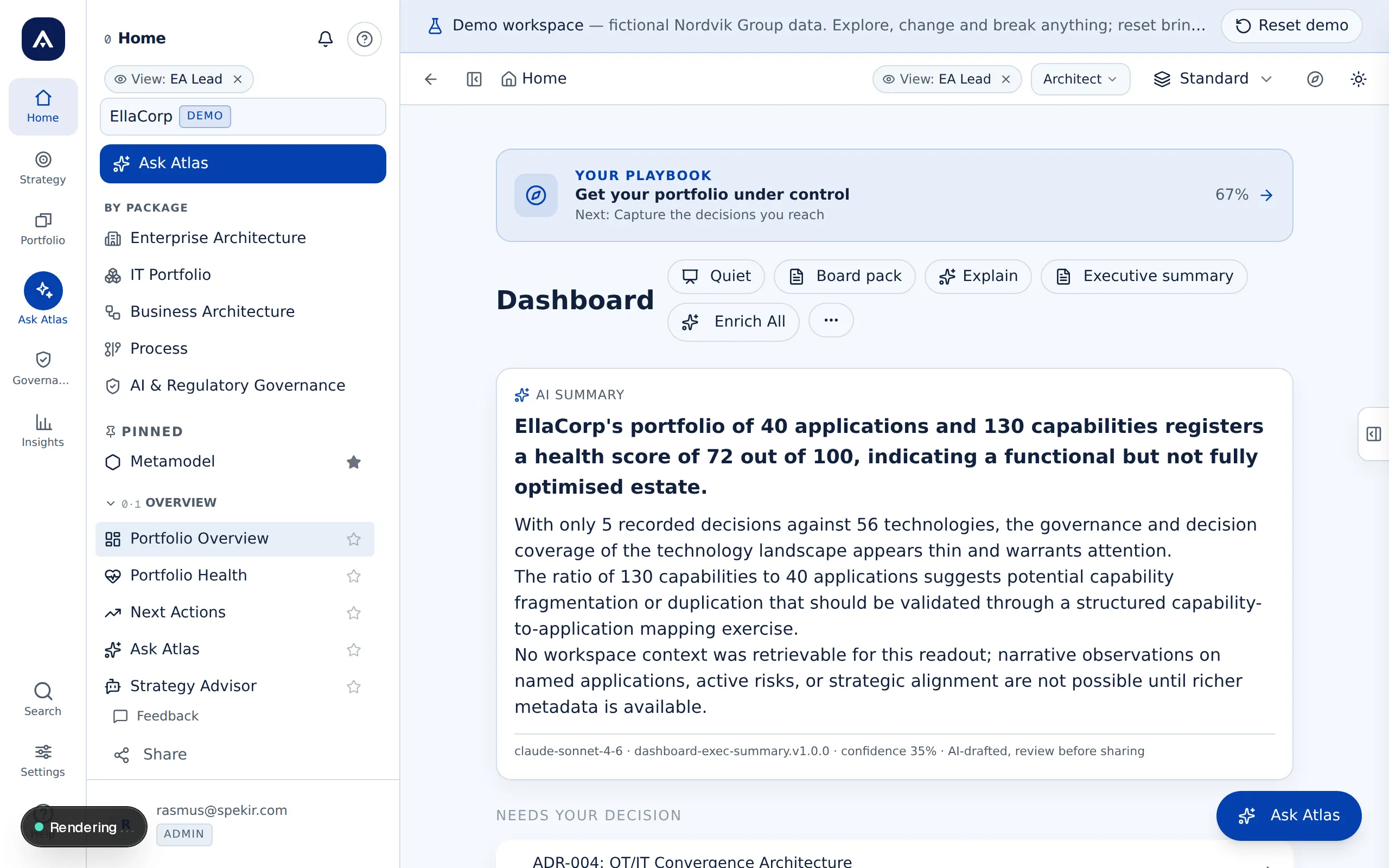
Portfolio Health Index rolls up cost, risk, ownership, and lifecycle signals into a single score. Trend line across quarters. Drill-down from score to app to owner in two clicks.
04Alignment
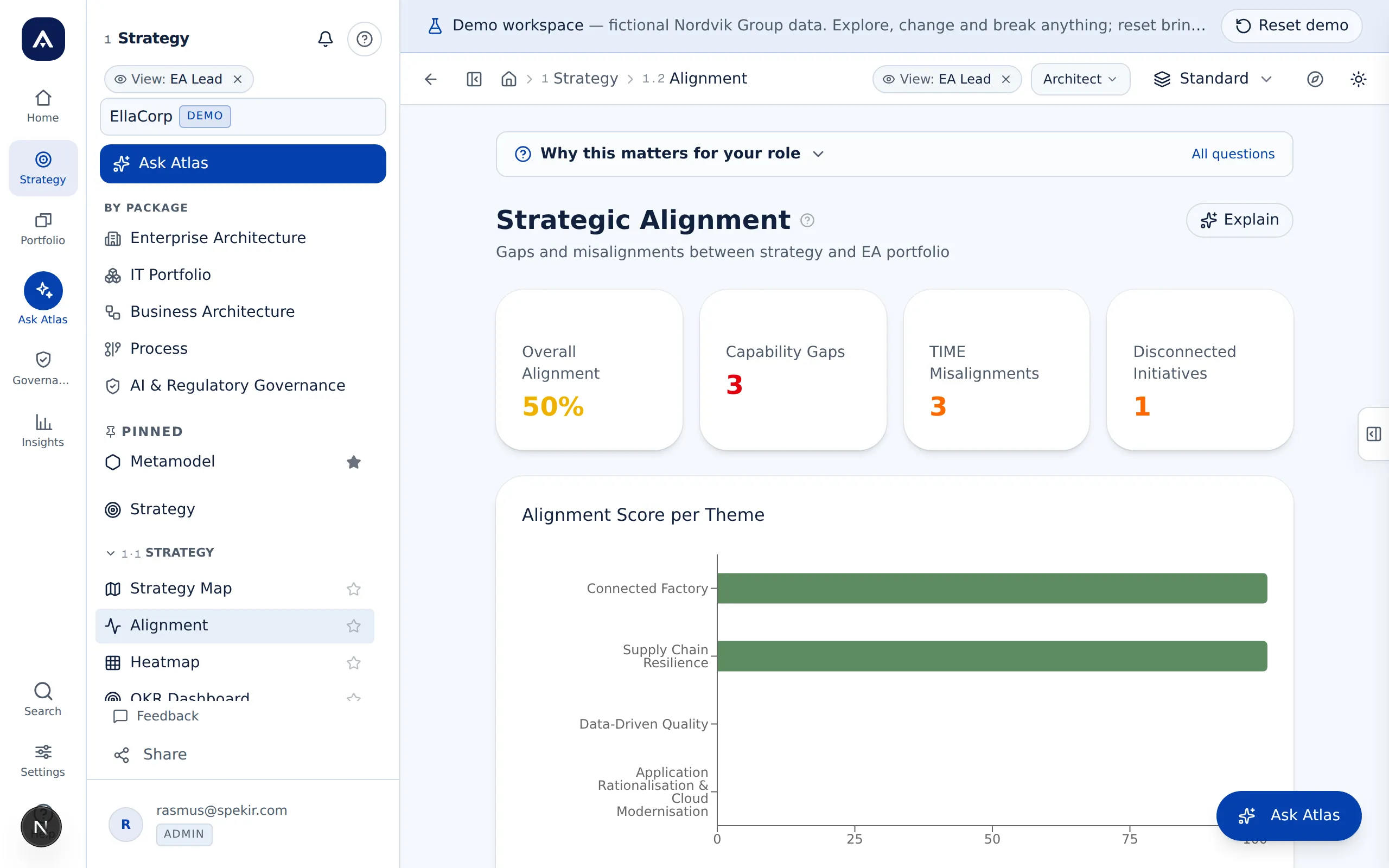
Every initiative tied to an executing system
Initiatives without applications surface in an 'unallocated' bucket. Apps without strategic anchor surface in 'floating'. You see the gaps before the CFO does.
05Cost meets strategy
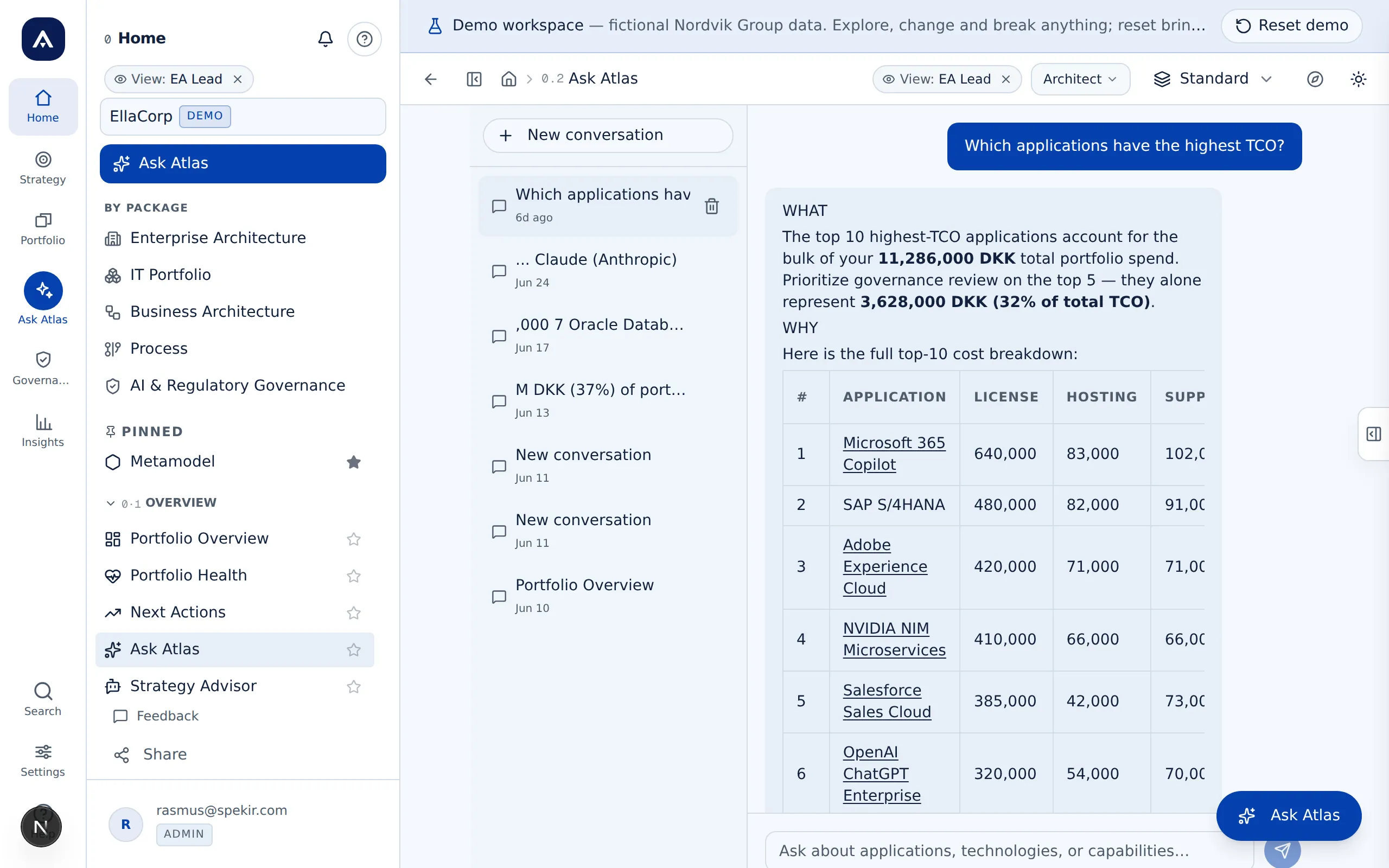
Prove which dollars earned their keep
Cost signals flow in from your TBM/finance source through connectors, then Atlas links each app's spend to the strategic initiative it serves. The value isn't rebuilding cost tooling — it's seeing spend next to the strategy it's supposed to fund.
06AI governance
Governed AI, board-ready
An AI use-case registry classified to EU AI Act tiers, with evidence and decisions attached — the answer when the board asks "are we compliant on AI".
07
How CIOs use Atlas
Before the board meeting
Portfolio Health, top risks, top investments, alignment gaps — pulled into one view, ready to present. Architecture on the agenda, not in the appendix.
When the budget is challenged
Cost signals per application, linked to the initiatives they serve. Which spend showed outcomes, which should be accelerated or cut — answered from the model, not from memory.
The rationalization round
Retire, consolidate, protect. Candidates surface with the reasoning linked, so the discussion starts from one shared list instead of competing spreadsheets.
Rolling out a new strategy
Paste the strategy document. Atlas structures themes, objectives, and initiatives — and shows which systems actually execute them.
The quiet drift check
Initiatives without applications land in 'unallocated'. Apps without strategic anchor land in 'floating'. You see the gaps before they become findings.
THE SPREADSHEET
It's not Excel's fault. It just wasn't built for this.
A spreadsheet is fine for listing apps. It just wasn't built to tie them to strategy, remember who decided what, or tell you when something has drifted from reality. That's where the gap opens up.
A spreadsheet doesn't connect strategy to architecture. You can see your apps, but not what they serve.
See capability map →A spreadsheet doesn't remember who decided what, or why. That context lives in someone's inbox.
See decisions →A spreadsheet doesn't classify on its own. You tag it by hand, row by row.
See AI classification →A spreadsheet doesn't surface drift. The numbers are right the day you type them, stale the week after.
See portfolio health →
FIT CHECK
Is Atlas a fit for your portfolio?
Thirty seconds, three questions, an honest answer. This isn't a sales form, and you don't have to hand over your email. If the answer is no, we'll say no.
WHY SPEKIR
Why I built Spekir
I spent twenty-five years as an Enterprise Architect, and most of the job came down to the same thing: making clear what we have, why we have it, and what we've decided about it. That knowledge lived in my head, in decks, and in spreadsheets, and it reset every time someone changed jobs or the org chart was redrawn. Atlas is the tool I kept wishing I had. Not another EA tool for specialists, but the EA role put in a box, so a midmarket team can get the overview without building a whole function around it. That's the whole idea, and it's still where I spend my time.
08
One model, four lenses. Strategy, applications, decisions, and alignment read from the same truth — so every role sees the same portfolio.
Strategy
Playing to Win, not slideware
Themes, objectives, and initiatives — structured, linked, and traceable to execution.
Learn moreApplications
Portfolio rationalization, AI-first
Owner, lifecycle, criticality, and TIME assessment on every application.
Learn moreDecisions
ADRs that don't rot
Decisions logged inline with the systems and capabilities they affect.
Learn moreAlignment
Drift, detected
Unallocated initiatives and floating applications surface automatically.
Learn moreBuilt in Europe. Hosted in Frankfurt. Designed for evidence backed AI.
Walk into your next board meeting with architecture on the agenda — not in the appendix.
Atlas generates a CIO-ready export in 30 minutes. Portfolio Health, top 5 risks, top 5 investments, alignment gaps. Ready to present.