Atlas
Enterprise architecture used to require an enterprise. Not anymore.
Atlas keeps one living model of strategy, business and IT. AI agents do the upkeep a whole EA team would otherwise do by hand, your people approve the changes, and the picture stays true. So it holds together as the organisation moves.
- Free during early access
- Hosted in the EU, Frankfurt region
- Bring your own model key, per workspace
No customer logos you can call yet. So, for now, no logos.
01Living model
A model that stays true, kept up by agents.
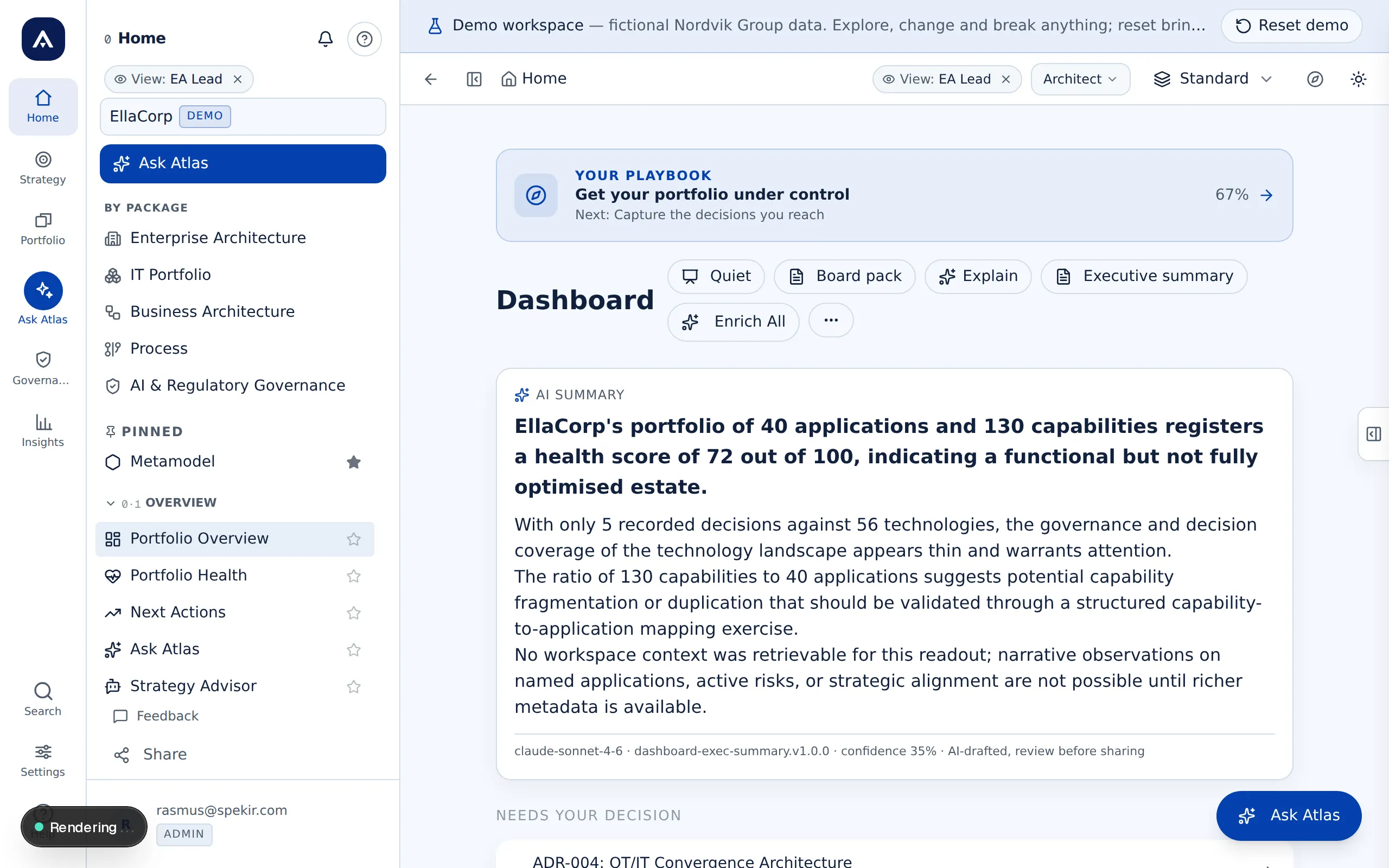
Architecture models normally die of manual upkeep and unanswered surveys. In Atlas, signals flow in on their own, agents write drafts, and owners confirm in a review inbox with one click.
Every fact shows its freshness, so you always know where the model is certain and where it has gone stale. We do not compete on how heavy the metamodel is. We compete on the model actually being true next quarter.
The model does not die of forgetting, because forgetting is no longer part of the system.
02Context for agents
One governed truth for your AI to ask.
Through the Model Context Protocol, your AI assistants pull architecture truth straight from the model: which system owns customer data, who approves changes, what supports which capability. Reads come back with citations.
Writes become proposals waiting for a human. Write with review is the standard, not a setting. A chatbot on top of a repository is not a governance model.
03Governance and evidence
The answer is a report, not a project.
The AI registry holds the whole AI portfolio with owner and purpose. The AI Act cockpit shows the obligations for your size on the updated timeline.
When someone asks which AI agents are running in the business and who signed off on them, you answer with the system, not a scramble. Governance and evidence are a by-product of the work, so it holds up under audit.
Want to see how Atlas is structured? The model and the map
Proof
From living model to the boardroom.
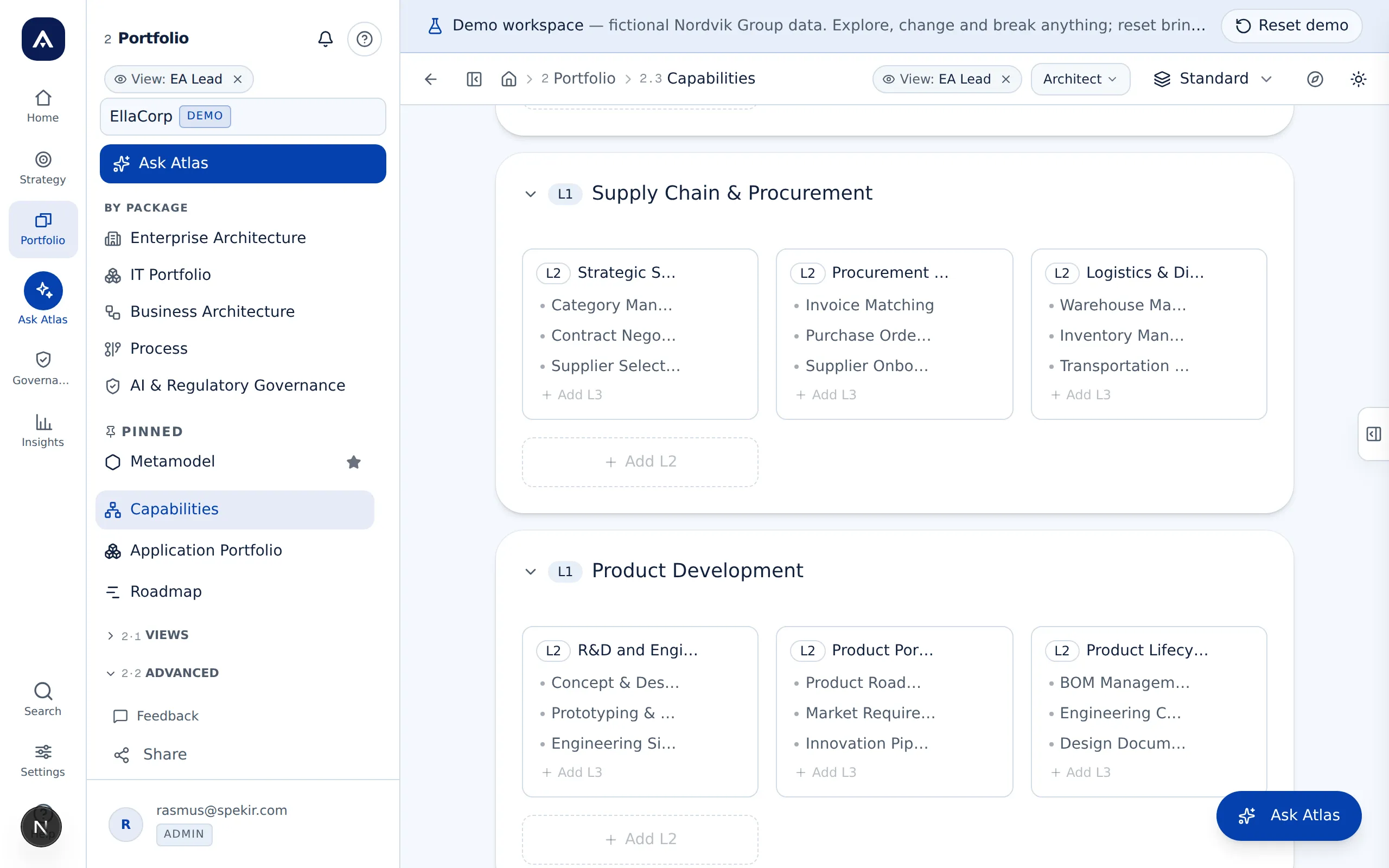
Five views come straight from the model, with no slides to reconcile: Capability Map, Value Streams, Strategy Map, Business Model Canvas and Portfolio. Present-mode for the meeting, print for the binder, deep-links for the detail. The numbers have sources, and the gaps are honest.
The model should work for the organisation. Not the other way around.
Questions
The questions we actually get.
- We do not have an EA team.
- Good. Atlas is built for you. The agents do the work an EA team would otherwise do by hand, and your existing people make the decisions. Five fields per system is enough to start, and the agents build the depth from there.
- We tried an architecture repository before. It died.
- Most do, usually because upkeep depended on people's memory and on surveys nobody answered. Atlas answers exactly that: automatic signals, agent-drafted entries, one-click confirmation. The model does not die of forgetting, because forgetting is no longer part of the system.
- Does the AI write directly into our model?
- No. Agents write proposals. People approve in a review inbox. Everything is logged. That principle is not a setting, it is the product's backbone. Write with review is the standard.
- Another AI tool for us to manage?
- The opposite. Atlas is where you manage the others from. Inventory, ownership, blast-radius and audit log are exactly the oversight most teams are missing today.
- Is our data safe?
- Your workspace is isolated at the database level, access is role-based, and every agent write goes through human review with a full log. GDPR flows are built in. And we only promise what we can show you in a demo.
- What does it cost?
- It depends on scope and agreement, and we would rather set the number with you than guess at it. Write to hello@spekir.com and we will work out the numbers for your situation.
See it with your own portfolio.
Get early access, or take the tour first. The tour needs no login and no email.